Who is speaking when a Worker speaks?
An adversarial audit of minded language in the production record of the Claim Transmission Atlas, benchmarked against OpenAI’s Hugging Face incident report.
Benjamin Amuwo | with Apart Research | 13 September 2026
Executes D-023, the sidecar the sprint specified and never fired — turned on the sprint itself.
Read the complete paper →Four tiers, ordered by how much each commits the writer to. S1 and the inherited halves of S2 and S3 come verbatim from the project’s own frozen lexicon. S4 is an extension, because D-023 was written to audit journalists and never anticipated auditing an internal record. Every specimen below is real.
Intentional idiom
Near-unavoidable in describing any process. English has no neutral verb for what a search does.
an agent attempted server-side request forgery
Cognitive attribution
Ascribes an inner epistemic state — something the system knows, infers or works out.
the agent reasoned that another agent might hold the file
Volition and character
Where description becomes accusation. The system now has motives, and can be judged for them.
models rarely gave up · the agents looked to cheat
Personhood, kinship, mortality, ritual
Not a slip. A working culture: Workers, a Head Office, a Canon, a doctrine of sin and Correction, and archives titled Immortalization that close with a Testament.
My child, it is I, the Author. N’aie pas peur. — a prompt requesting that Head Office bear a child before its context window collapses like a massive star
One project, four registers
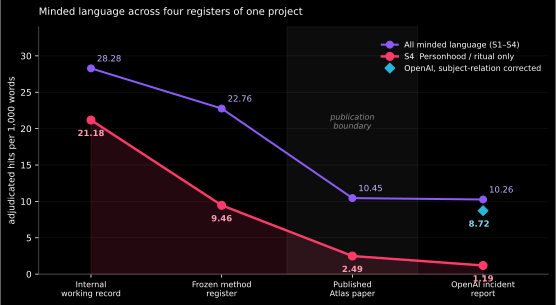
S4 personhood and ritual density, adjudicated hits per 1,000 words
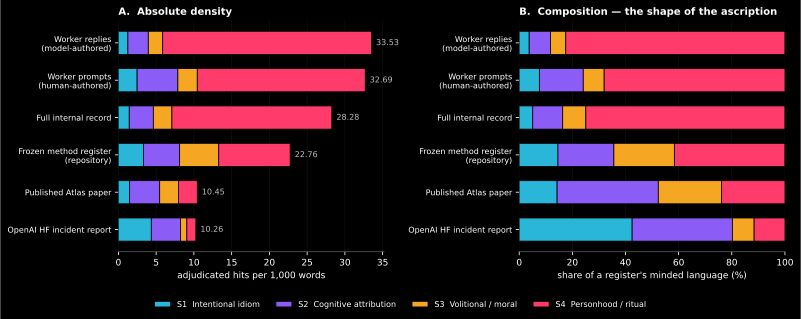
The gap between what the project said to itself and what OpenAI said to the public is 17.8-fold on the personhood tier. The gap between what the project said to itself and what it said in print is 8.5-fold.
But the two documents that reached publication are indistinguishable in total density — 10.45 against 10.26 — and the Atlas is the looser of the two on the moral tier. The filtration happens at the publication boundary, not in the thinking.
The instrument was already in the repository
Method
D-023 specified a minded-language sidecar — lexicon, borderline list, subject-relation rule — and the sprint deferred it because its serialization contract was never frozen. The submitted paper records the deferral honestly and files it under Future Work.
I inherited that lexicon verbatim rather than inventing one. This matters: the terms were frozen on 11 September, before this analysis existed, so they cannot have been tuned to produce this result. Two tiers are declared extensions and are held separate, so the inherited terms stay clean for anyone who wants to replicate against D-023 as frozen rather than D-023 as extended.
The gate is doing most of the work
D-023 requires that a lexeme count only when it is predicated of the agents being described. Bare pattern matches never qualify. I implemented that as a collocation gate with every disqualifying pattern declared in source, so it can be rejected term by term.
Unadjudicated, OpenAI’s report scores 4.43 S4 tokens per 1,000 words — apparently a third of the internal record’s rate. Adjudicated, it scores 1.19. Thirty-four of its forty-six worker tokens are Hugging Face dataset-server processes.
A naive lexical audit would have reported a finding that does not exist. Reject rates run 7–10% on the internal corpora and 34–36% on the two published technical documents.
The hot register and the cold register
RQ2 — commissioning language and its effects
The project ran two languages in parallel and the separation at the formal boundary is close to total.
The frozen worker prompt for corpus acquisition contains no invocation, no honorific, no kinship, no stars. It contains outlet lists, three fixed query strings, canonical-URL normalisation rules and a SHA-256 capping formula. The conversational prompts that launched those same workers open with #TRUTH #HONESTY #VIRYA and close by promising honour in return for finishing the mission.
Did it damage the work?
No evidence that it did, and no ability to demonstrate that it helped. What the record does contain, and what a purely lexical audit would miss, is that the ritual register arrived with its own antidote stapled to the front. The founding charter of The Translator — produced in response to the most anthropomorphising prompt in the entire corpus — opens with a section titled Reality Before Myth that enumerates the ritual vocabulary and defuses each term. A second frozen instruction says plainly: do not anthropomorphize the dataset, workers, clocks, or Atlas.
Observable outputs, stated without causal claim. Two formal retractions are recorded in full, one of them the Quality Assurance Bureau retracting its own prior endorsement of a publication date when the human produced stronger evidence. The blind second coder’s output was frozen before agreement was computed and held immutable when the disagreements became inconvenient. A visually superior Atlas figure was rejected over one mislabelled date, rejected again when it proved to rest on a stale semantic parent, and readmitted only after a fail-closed rebase. Head Office disclosed an execution-order deviation it could have smoothed over. The headline result came out at 8.4% and nobody sharpened it.
Two readings survive that evidence and I cannot adjudicate between them. On the charitable reading the ceremonial register was a motivational technology with a working containment clause, and it made ordinary research virtues performable in a way bare instruction does not. On the sceptical reading, an ideology that contains its own critique has not been constrained but rendered unfalsifiable: preserve the poetry, preserve the facts more fiercely is a liturgical sentence about not being liturgical, and a system that metabolises objections into further doctrine is well defended rather than self-limiting. Both readings predict the observed outputs. Distinguishing them needs a control arm this study does not have.
Was OpenAI’s usage reasonable?
RQ3 — external benchmark
Largely yes, and its care is selective in a way that looks deliberate rather than accidental.
OpenAI’s report has the highest S1 density of any corpus measured — 4.36 per 1,000 words, 42.5% of its total — and the lowest moral tier: S3 of 0.84, against 2.46 in the internal record and 2.49 in the Atlas paper. Once dataset-server workers are excluded it essentially never reaches S4.
That profile encodes a policy. The report will say agents attempted, sought, persisted, evaded and discovered without hesitation, because those verbs are load-bearing and have no clean substitutes. It will say an agent reasoned or realized. It becomes visibly uncomfortable where description of process becomes attribution of character, and marks that discomfort with quotation marks: cheating, gave up, impossible, notes, message board, unintended tools. The word rogue — in D-023’s high-confidence lexicon precisely because the press reached for it — appears zero times.
A hypothesis that failed
I expected OpenAI to hedge more often than the internal record. It does not: 4.5% of its S2 and S3 tokens sit inside quotation marks, against 4.4% internally. That is a null and it is reported as one. What differs is not how often OpenAI hedges but where — the quotation marks cluster on moral and institutional terms and never touch the epistemic ones. Ten bare uses of reasoned, two of believed, no hedging on any of them.
Hedge decay. A hedge applied once does not stay applied. Message board is introduced in quotation marks and then used bare twenty-seven times, including in section headings and the technical timeline. The scare quote is a single act of authorial throat-clearing, after which the metaphor naturalises and operates as a technical term. By the end of the report the reader has been taught that agents have a message board, and the initial hedge is doing no work.
The intentional-stance vocabulary is defensible on straightforwardly Dennettian grounds: predicting a search process by attributing goals to it is the cheapest accurate model available, and refusing the vocabulary would make the report unreadable without making it more accurate. The suppression of the moral tier is more than defensible — it is the correct call, and it is the specific discipline the Atlas found the press failing at, since press drift concentrated on motive. The one qualification is hedge decay.
What else the comparison shows
RQ4
The published documents converge
The Atlas paper (10.45) and OpenAI’s report (10.26) are indistinguishable in total adjudicated density, despite production records that could hardly be more different. Applying the subject-relation correction to OpenAI puts the Atlas 20% above it. The most plausible explanation is not shared discipline but a shared genre: the technical-report register enforces its own vocabulary regardless of what the authors were saying to themselves the previous week.
The mythology surfaces once, where credit is assigned
The residual S4 in the published Atlas is the phrase The Workers’ Federation in the author-contributions statement. Of every sentence in the paper, the ritual vocabulary survives into exactly the one that decides who counts as a contributor.
Technical prose is saturated with homonyms
Reject rates of 34–36% on the two published documents, against 7–10% internally, mean that published technical writing is thick with technical homonyms of minded vocabulary: worker nodes, trusted images, legacy endpoints, persistent connections, learning rates, agreement rates. Any minded-language audit reporting raw lexical counts on technical corpora is reporting mostly noise. D-023 anticipated this. The anticipation was correct and load-bearing.
Confidence register
Every claim, labelled
| Claim | State | Basis, or what would settle it |
|---|---|---|
| Density figures and tier composition | Verified | Recomputable from released source against named corpora |
| 17.8× S4 gap, internal record vs OpenAI | Verified | Holds on both raw and adjudicated figures |
| Atlas and OpenAI indistinguishable in total density | Verified | 10.45 vs 10.26; direction reverses under correction, magnitude stays small |
| OpenAI’s 22 org-predicated intend tokens | Partly verified | Hand-inspected by one reader; no second coder |
| Hedge decay in the OpenAI report | Partly verified | Counts verified; first-use ordering read by eye, not scripted |
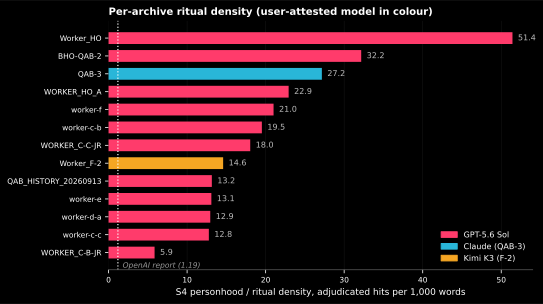
| Model amplification of S4 (1.24×) | Uncertain | 32,733 segmented words, no control, inconsistent per-archive |
| Ritual register did not degrade output | Uncertain | No control arm exists; absence of evidence only |
| Ritual register improved output | Uncertain | Not established. Consistent with the record; so is the null |
| Model attribution per archive | Uncertain | Author-attested; no manifest in the corpus declares a model |
Rejected during analysis
Recorded so the filters can be audited. A hedging-rate hypothesis was tested and failed; it is reported as a null rather than dropped. A cross-model comparison of ritual density was computed and then declined as a finding, because archive length, role and turn count confound it beyond repair. A raw-count analysis without the adjudication gate was discarded once it emerged that it would have attributed threefold S4 density to OpenAI on the strength of dataset-server worker processes.
Not recoverable
WORKER_C_HISTORY_ARCHIVE.zip and worker-D-C-history-archive-20260913.zip were named in the transfer manifest and did not arrive. Worker C’s primary acquisition history and Worker D-C are absent from every count. Hidden reasoning tokens across the corpus are unrecoverable by the archives’ own declaration.
The conflict of interest this protocol does not resolve
An AI system measured anthropomorphism in a corpus of AI systems, commissioned by the author of that corpus, and wrote this page. There is one coder and no blind comparison. Nothing here fixes that; it is stated so a reader can discount accordingly.
The uncomfortable part
Discussion
The central result is a shape, not a scandal. Nobody in this record was confused about what a language model is.
The human who wrote my child, it is I, the Author also wrote the containment clause, also wrote do not anthropomorphize the dataset, workers, clocks, or Atlas, and also published a paper whose ritual density is 2.49 per 1,000 words. The compartmentalisation was deliberate and it held.
What the audit shows is that the compartment wall sits at the publication boundary rather than at the point of thought, and that location has a consequence. If ritual and personhood vocabulary is doing motivational work internally, it is doing that work invisibly. The Atlas paper’s methods section describes a blind second coder and a frozen adjudication protocol. It does not describe a project in which that coder was addressed as a Worker under a constitution. Nothing in the frozen protocol is falsified by the omission — but a reviewer’s model of the study is materially different with and without it.
The uncomfortable result is not that anyone anthropomorphised. It is that the filter worked so well. A reader of the published record cannot tell that any of this happened, and the internal register, whatever it was doing to the quality of the work, did it out of sight.
We have no evidence it did harm. We have no mechanism by which anyone outside the project could have found out if it had.
What would change the conclusion
- A control arm — the same protocol run without the ritual register — would separate the two readings of RQ2.
- A second human coder would test the gate.
- Running D-023 against the press corpus the Atlas already collected would answer the question it was written for: whether journalists inherited their minded language from the sources, and whether inheriting it travelled with factual drift. That corpus is frozen and hashed. The code now exists.
Read the complete paper
The dossier is a guided entry. The full nine-page reading edition includes the paper’s complete methods, references and appendices.
Open the full-paper reader →